EMT Practice Test

1. Question Content...


Question List

Question1: A performance improvement project was initiated at the beginning of the flu season to increase the influenza vaccinations given in a pediatric clinic. The organization implemented a template to document patient influenza vaccine status and to offer the vaccine to any patients identified as not having been vaccinated. To evaluate and document the process improvement results over time, the quality professional should use which of the following?

Question2: A strategic plan Is developed by making decisions about the future of the organization. Which of the following Is true about the strategic plan?

Question3: A graph shows a 50% complication rate for appendectomies. Which of the following would be most important to assist the reader in interpreting the data?

Question4: A hospital collects patient satisfaction data by mailing surveys to patients discharged home and analyzes the responses they receive. What is the most significant limitation of this sampling methodology?

Question5: Which of the following is the most effective method to identify adverse events that cause harm to patients?

Question6: To effectively communicate performance indicator results, information should be disseminated to the

Question7: Which of the following should a healthcare plan use to collect satisfaction data from its health plan members?

Question8: Which of the following actions best illustrates an organization has begun the work necessary to achieve the Malcolm Baldrige Award?

Question9: A positive correlation is seen in a scatter diagram when

Question10: A healthcare system has multiple medical clinics across a large geographic area. What is the best way to deliver education to assure continuous survey readiness?

Question11: The clinic has a goal to reduce the Healthcare Effectiveness Data and Information Set (HEDIS) measure of ' the percent of diabetic patients with a HgA1c greater than 9.0% for accreditation. Who should be Included on the quality Improvement team?

Question12: A criterion is considered valid if it

Question13: When allocating limited resources to meet strategic objectives, management decisions should be driven by

Question14: Which of the following is one purpose of clinical pathways?

Question15: A performance improvement coordinator is having difficulty keeping a new team focused on its goal of decreasing patient waiting times. To understand why the team process is not working, the team leader should initially assess the

Question16: A healthcare quality professional Is facilitating the establishment of a Quality Council for an outpatient surgery center. The following positions have been selected for membership: medical director, CEO. and CFO.
Which of the following Is the most appropriate Individual to add?

Question17: A provider's Ongoing Professional Practice Evaluation (OPPE) profile is shown below. In this organization, if a provider partially meets or does not meet performance expectations, they are referred to peer review for a Focused Professional Practice Evaluation (FPPE).
Fully Meets: >80% of measures at threshold
Meets: 65% to 80% of measures at threshold
Partially Meets: 40% to 64% of measures threshold
Does Not Meet: <40% of measures at threshold
After reviewing this provider's overall profile, what should the healthcare quality professional suggest?

Question18: Which ofthe following should be a part of an organization's program of continuous readiness for accreditation?

Question19: The preferred culture in promoting patient safety

Question20: In a confidential reporting system, the reporter's Identity Is

Question21: An internal customer of the admission process in a skilled nursing facility is the

Question22: The hospital administration has requested data to support an initiative to reduce barriers to healthcare In the community. Which of thefollowing Information Ismost appropriate for the quality professional to provide for initial planning?

Question23: An important responsibility of each team member working on a team project is to

Question24: An organization wants to promote Six Sigma across its enterprise with all staff members having general exposure to Six Sigma methods. Which of the following best differentiates the role of the various belts?

Question25: The quality manager needs to identify a set of process measures to improve wound care outcomes. The first step should be to

Question26: A healthcare quality professional receives complaints from numerous patients that the registration process is inefficient. Which of the following should be used to best identify customer expectations, perceptions, and improvement opportunities?

Question27: The health quality professional recognizes that which of the following events should be reported to regulatory or accreditation organizations?

Question28: A hospital is using the above chart to monitor the average length of stay (ALOS) for patients diagnosed with acute myocardial infarction (AMI). Which of the following conclusions should be made?

Question29: Which of the following is an example of improving primary prevention strategies?

Question30: A focused professional practice evaluation (FPPE) Is Initiated

Question31: The most important determinant of quality improvement success is

Question32: Which of the following infection prevention techniques represents a human factors engineering solution?

Question33: An organization Is evaluating the data used to measure compliance with medication reconciliation by clinic.
Three abstractors have been assigned to collect the data. The compliance data by abstractor and unit are below:
Based on this table, which of the following Is the best next step to evaluate accuracy and reliability ol the data?

Question34: Which of the following strategies promotes timely completion of a quality improvement project?

Question35: A managed care peer review committee should obtain which of the following first?

Question36: A CEO and chief nursing officer have requested a new quality initiative to reduce patient falls. One of the first steps in starting this new quality Improvement Initiative should include

Question37: Which of the following is an example of using human factors engineering to improve patient safety?

Question38: Accountable care organizations (ACOs) utilize "hot spotting" as a population health tool to:

Question39: Which of the following is the best example of a patient-centered approach in healthcare?

Question40: Which of the following represents a quality management system with criteria that serve as a tool to assess and award best-in-class organizations?

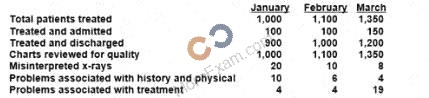
Question41: Anemergency department's quality improvement report for the first quarter showed the following data:

What was the approximate overall problem rate for March?

Question42: A recent Journal article has Identified three new patient safety Initiatives. When reviewing these Initiatives, the first action of a healthcare quality professional Is to

Question43: A hospital is considering changing the process of admissions from the emergency department. To support patient safety when this new process is deployed, the healthcare quality professional should suggest which of the following actions during the design stage of the process?

Question44: Which of the following is the best method of determining improvement priorities to benefit the health of the community?

Question45: Which of the following conclusions might be drawn from failure mode and effects analysis (FMEA)?

Question46: The primary purpose of practice guidelines is to

Question47: A hospital's leadership team has asked the quality professional to review alternative accreditation options for the organization. The quality professional recommends the:

Question48: Which initiative should a quality professional promote in an organization seeking to optimize value-based reimbursement?

Question49: Which of the following would be the best methodology to reduce referral wait time?

Question50: A researcher decides to look at every fourth patient admitted each day and record if the IV is properly labeled, starting with a randomly selected patient. This is known as which of the following types of random selection?

Question51: A patient safety program can best be enhanced by which of the following technologies?
Question52: Prior to the implementation of a new electronic health record (EHR), a facility charters a failure mode and effects analysis (FMEA) team. After mapping out the process for creating a new patient chart, the next step should be to:

Question53: An emergency department's quality Improvement report for the first quarter showed the following data:

What was the approximate overall problem rate for March?

Question54: Even when appropriate processes areinplace, errors can occur. Understanding this, leaders coordinating a patient safety program should focus on

Question55: The collection, analysis, and Interpretation of data for planning, Implementing, and evaluating health programs is

Question56: An ambulatory care practice has reviewed data to identify patients with multiple visits to the emergency room within the last six months. The population health management technique for this type of data review is called

Question57: Continued evaluation of a quality improvement initiative occurs within which of the following phases of the DMAIC process?

Question58: An organization conducts daily briefing sessions. Which of the following questions demonstrates a culture of safety?

Question59: A recent journal article has identified three new patient safety initiatives. When reviewing these initiatives, the first action of a healthcare quality professional is to:

Question60: Based on the chart below, which of the following should be addressed first?

Question61: A CEO has directed a quality improvement council to develop objectives to meet an identified goal. When developing objectives, the council must remember to

Question62: An orthopedic surgery practice has been working on Improving patient safety for the last 3 years. The following data table is available:
Which of the following Is the most appropriate conclusion about patient safety outcomes?

Question63: To best achieve a low rale of harm In spite of Inherent risks In healthcare, an organization must

Question64: Annual evaluation of a quality Improvement process must

Question65: An organization is shifting paradigms from top-down leadership to participatory management. The process of moving forward includes the four identified phases below:
gathering baseline data
evaluating effectiveness and improvement
making the commitment
implementing the program
Which of the following is the most logical sequence for these phases?

Question66: Leadership at an outpatient multi-specialty clinic Is working toward becoming a high-re I lability organization. In the past week, there have been three medication errors with high-risk medications in the procedure area. Which of the following responses by leadership Is consistent with high-reliability principles?

Question67: A hospital installed a new patient safety event reportingsystem. During the failure modes and effects analysis (FMEA), decreased use of the system and complexity of reporting were identified as potential failures. What should the team use to determine which failure mode to address first?

Question68: A national health plan has recently acquired a local health plan. At the year anniversary of the merger, the - local health plan staff still struggles with the transition to the new organizational values. Which of the following Is the most likely explanation for the difficulty?

Question69: Clinical staff at a hospital inconsistently document the fall risk assessment upon admission. What approach should the quality improvement professional recommend as a priority?

Question70: Which of the following tools would best display nosocomial infection rates over time?

Question71: Organizations with a positive safety culture are best characterized by

Question72: A healthcare quality Improvement team is working on an action plan to address medication system defects.
Based on the data from the chart below, what would be the next step?

Question73: A hospital's quality professional notices a high 30-day readmission rate for patients with chronic obstructive pulmonary disease (COPD) exacerbation. What is the quality professional's next best step?

Question74: Which of the following should the team do next?

Question75: A performance Improvement team has been formed and assigned to reduce wait time from clinic check-In to seeing a provider. Which tool would be most useful for the team to create at the first meeting?

Question76: A quality professional was asked to assist with strategic planning. Which of the following should have the primary impact on the quality and performance improvement goals?

Question77: Which of the following regulatory agencies oversee development of electronic clinical quality measures (eCQMs)?

Question78: A healthcare organization wishes to develop an education plan for quality and patient safety. Based on adult learning principles, the planned education Is most likely to be effective when

Question79: A home health agency's Performance Improvement Committee has decided to base staff educational programs on aggregated occurrence report data. Due to budgetary and time constraints, not every area identified from the data can be addressed. Which of the following would be most useful to the committee in determining their educational targets?

Question80: The purpose of sentinel event review of never events is to

Question81: The performance improvement team developed a prioritization matrix based on the identified improvement opportunities. Based on the information below, what would be the first improvement effort implemented?

Question82: Which of the following is an example of active surveillance?

Question83: When implementing a new process or procedure, which of the following tools should be used to anticipate and prevent potential problems?

Question84: Which of the following characteristics best describes a learning organization?

Question85: How can a quality professional best engage stakeholders in the organization's quality efforts?

Question86: A root cause analysts (RCA) was conducted tor an event related to a delayed high-priority alarm response.
Alarm fatigue was determined to be a root cause. Which of the following Is the most appropriate first Intervention?

Question87: There is an increased incidence of type 2 diabetes among patients living near a healthcare organization as compared to the state. Considering social determinants of health, which of the following strategies can be used to address this problem?

Question88: A 300-bed healthcare organization has decided to apply for accreditation with a new accreditation body. The accreditation readiness coordinator should first

Question89: An organization recently lost its deemed status due to non-compliance with grievance process regulations.
Which of the following standards would the quality professional research to identify grievance process requirements to correct the cited opportunities for improvement?

Question90: A long-term care facility has experienced an Increaseinoccupational Injuries among nursing staff and increased patient harm as a result of unsafe patient handling. Which of the following is the best example of a human factors design solution this facility could Implement?

Question91: The main goal of a clinical pathway/guideline Is lo

Question92: Technology design that prevents a certain action, or requires that another action happen first, is said to have

Question93: A healthcare quality professional has the following data on a hospital's surgical site infection rates:
Procedure
Hospital Infection Rate
95% Confidence Interval
State Mean Infection Rate
Total Hip Replacement
0.4%
0.2%-0.6%
0.9%
Total Knee Replacement
1.1%
0.8%-1.2%
1.0%
ACL Reconstruction
1.5%
1.4%-1.6%
1.5%
Total Shoulder Replacement
1.3%
1.0%-1.6%
0.9%
Which procedure is the best area for focused quality improvement?

Question94: The primary focus of Six Sigma methodology is

Question95: In a quality improvement team, the primary role of the facilitator Is to

Question96: An organization has Implemented a quality improvement project. The goal is a mean compliance rate of 90%.
The results of observations are found in the table below:

Which focus area presents the greatest opportunity for the organization?

Question97: When working with a new quality Improvement team, the quality professional should stress the importance of

Question98: Prior to a regulatory or accreditation visit, a healthcare quality professional should:

Question99: Which of the following tools will best help a quality professional to exhibit project activities and results?

Question100: The trend of a variable over time is best illustrated by a:

Question101: Where in the process of ensuring correct surgery does a "time-out" take place?

Question102: Which of the following best describes the goal of the Healthy People Initiative?

Question103: Which of the following is an example of a social determinant of health used to monitor a quality improvement initiative?

Question104: An organization Is tracking Infection rates to determine the benchmarks for the next fiscal year. The team Is analyzing the data for Infection rates. Which key variables are missing to interpret the graph?

Question105: Which of the following is the quality professional's first step prior to implementing a new infection prevention protocol in the clinic?

Question106: Which of the following payment systems carries the most financial risk for a provider?

Question107: A rapid cycle improvement team has met for six months. The team set a clear aim, gathered data, and identified barriers, but has not conducted any tests of change. Team members are also not completing assignments. Which of the following tools should be used to get the team back on track?

Question108: What Is the Initial step the quality professional should take when the organization's performance on a patient satisfaction strategic goal Is below the desired performance?

Question109: A nurse inadvertently hung an IV medication on the wrong patient's IV pump, but discovered the error prior to initiating the infusion. Patient harm was averted, and the nurse disclosed the error to a healthcare quality professional. The quality professional should

Question110: An initial step to address health disparities within a population is to:

Question111: A pulmonologist is gathering social determinants of health data from their patients. Which of the following best explains the purpose of collecting this data?

Question112: A quality professional is creating a training session for clinical leaders about quality improvement. Which of the following should be incorporated into the training?

Question113: A local health center is launching a community health assessment. What data is recommended to identify the potential needs of the population?

Question114: A performance improvement team is looking at data from similar medical centers to improve patterns of care.
This method of assessment is known as:

Question115: A hospital received 50 Incident reports describing falls that occurred within aone-monthperiod. Which of the following actions should be taken?

Question116: Which team role is responsible for maintaining improvements after the implementation of a quality initiative?

Question117: A healthcare quality professional has been asked to assess a facility's patient safety culture. Which of the following should be surveyed?

Question118: A skilled nursing facility has implemented a process to address delays in diagnostic test result availability to the ordering provider. Which of the following measurements will best document improvement in this process?

Question119: The quality professional has been asked to perform chart audits on a population to assess how often hypertension is being addressed by clinicians when hypertensive patients presented to the clinic in the last year. The clinic has over 8,000 patients diagnosed with hypertension. Which of the following would be most appropriate for the quality professional to consider when selecting a sampling methodology?

Question120: Which of the following is the most effective means of communicating commitment to patient safety?

Question121: Choosing a small number of items to represent characteristics of the whole is an example of

Question122: Through routine collection of incident reports, an increase in medication errors was noted over a period of 6 months on 2 nursing units. Which of the following is the best method of displaying the data to illustrate this finding?

Question123: Which of the following is the most effective way to promote a safe transition of care to home for patients leaving a hospital?

Question124: An extended care facility measures the percent of time a comprehensive exam is completed within 96 hours of admission. This is an example of which of the following types of measure?

Question125: Each department in a hospital self-monitors and reports hand hygiene data each quarter. Results typically fall within the 58-72% range, with the exception of Respiratory Therapy, which consistently reports 100% compliance. Which of the following steps should a healthcare quality professional take next?

Question126: Which of the following is the best example of a non-value added step in the healthcare environment?

Question127: The quality professional is preparing for the annual review of a quality management program. The most important objective of the review is to evaluate the:

Question128: A key concept in patient safety planning is to design procedures that

Question129: Which of the following statements most accurately describes health literacy?

Question130: A nursing unit has collected the following data:
50 medical records reviewed
Nurse A
Nurse B
Doctor A
Doctor B
Timely initial assessment
45
40
10
25
Incomplete documentation
0
12
26
20
Which of the following is the best method to display this data?

Question131: Which of the following tools depicts a sequence of events in a process?

Question132: A nursing unit has collected the following data:
Which of the following is the best method to display this data?

Question133: A continuous quality improvement team has proposed a major change in the billing process for home health service. Staff acceptance of the change is best facilitated by:

Question134: In an aging population, one of the challenges associated with the use of practice guidelines is

Question135: Multi-voting Is frequently usedinwhich of the following steps of the quality Improvement process?

Question136: Which type of data could best be used to help identify health-determinant information in a patient population?

Question137: Following evaluation of the compounding process used by a pharmacy, the batch compounding consistently yields 12% more drug than Is needed. The excess Is stored until used or expired. Which of the following types of waste should be recorded when reporting this finding?

Question138: The quality improvement (QI) specialist recognizes that any documents related to medical peer review are:

Question139: A healthcare quality professional has identified a gap In practice from regulatory requirements. The quality professional should

Question140: Which of the following tools should be used to determine the root cause of variations in a process?

Question141: The health department cited a clinic for storing used instruments improperly. From a quality perspective, which of the following should be done first?

Question142: Which of the following would best facilitate the development of priorities?

Question143: A quality Improvement team has Identified specific changes to Implement for a quality Improvement Initiative. As the next step, the team would like to establish a concrete timeline for implementation. Which of the following is the best tool to use for this step?

Question144: For which incident would a process improvement manager be required to perform a root cause analysis (RCA)?

Question145: Before patient outcome data can be used for benchmarking, the data should be

Question146: Using clinical guidelines based on scientific evidence will most likely

Question147: Which of the following is the most effective method to identify adverse events that cause harm to patients?

Question148: One of the first steps in preparing for an organizational accreditation survey Is to have a quality professional

Question149: Which of the following is a key component in establishing a comprehensive populationhealth management program?

Question150: An emergency department's quality improvement report for the first quarter showed the following data:
Which of the following additional information should be included in this report for each month?

Question151: Data for an organization's annual Influenza vaccine administration yields the following results:

What is the median for the organization's annual vaccine count?

Question152: A director at a large health system is tasked with building a new population health program. What is the director's first step?

Question153: A performance improvement council has been directed to set up a communication plan for spreading an innovative telehealth program throughout the healthcare system. Which of the following groups must the council include in the communication plan?

Question154: Which of the following stages may cause continuous quality improvement teams to dissolve prematurely?

Question155: The quality improvement tool used to identify special-cause variation in a process is a:

Question156: The office manager of a primary care office reviewed the performance of the providers and noted that one provider has not been completing depression screenings consistently for patients in the previous month. The manager's next action is to:

Question157: A quality professional was asked to assist with strategic planning. Which of the following should have the primary impact on the quality and performance improvement goals?

Question158: How can a quality professional best engage stakeholders in the organization's quality efforts?

Question159: Which of the following Is an example of a population health strategy?

Question160: Which of the following is the role a healthcare quality professional should play in strategic planning?

Question161: A healthcare quality professional Is assisting an organization with evaluating patient safety actions that will prevent errors of omission. Which of the following systems will most likely be effective?

Question162: Medication reconciliation Is described as

Question163: In reviewing information offered by the Agency for Healthcare Research and Quality (AHRQ), the quality improvement (QI) specialist recognizes that the three broad aims pursued by the National Quality Strategy are

Question164: The median is defined as the

Question165: A healthcare organization has recently launched a diabetes center of excellence to address the needs of its patients with advanced diabetes. The implementation of this program would fall into which of the following types of prevention?

Question166: A stated purpose of the National Committee for Quality Assurance (NCQA) Healthcare Effectiveness Data and Information Set (HEDIS) public reporting is that accountable health care should:

Question167: In aligning an organization's performance Improvement plan with strategic goals, a healthcare quality professional should consider

Question168: An improvement project was implemented to expand utilization of primary care services in a rural area where only 5% of residents sought primary care. The team established a goal of 20% of residents using primary care.
The table below shows the results for the four months following implementation of the improvement:
% Residents Using Primary Care
Time | %
Baseline | 5%
Month 1 | 15%
Month 2 | 20%
Month 3 | 21%
Month 4 | 22%
Which of the following should the quality professional recommend to the organization?